
10 Fun Ways to Teach Animal Movement Words to Preschoolers

Updated: Sep 7
Preschoolers learn with their whole bodies. Ask them to “slither like a snake” or “gallop like a horse,” and suddenly vocabulary is not a list of words. It is a wiggle, a stomp, a giggle, and a memory.
Animal movement words are especially fun because they connect language, imagination, and gross motor play. Words like hop, crawl, waddle, leap, pounce, flutter, and slink help children describe what they see, hear, and do. They also build listening skills, body awareness, and confidence using new language.
The best part is that these lessons do not need fancy materials. A few picture cards, open floor space, and an enthusiastic adult can turn vocabulary practice into a favorite preschool activity.

Start with movement that children can feel
Young children understand action words faster when they can act them out. Before asking them to define a word, let them experience it.
1. Play animal charades with simple movement words
Animal charades is a classic for a reason. It gets children moving, laughing, and guessing.
Choose a small set of animals and match each one with a clear action:
Animal | Movement word | Kid-friendly cue |
Frog | Hop | Bend your knees and spring up |
Snake | Slither | Wiggle low on your belly |
Horse | Gallop | Step and chase with your feet |
Bear | Crawl | Move on hands and feet |
Penguin | Waddle | Take tiny side-to-side steps |
Bird | Flutter | Flap gentle wings |
For younger preschoolers, ages 3 to 4, act out the movement first and invite them to copy you. For older preschoolers, ages 4 to 5, let them draw a card and perform the action while others guess.
Keep the focus on the verb. After each turn, say the full sentence together:
“We hop like frogs.”
“The snake slithers.”
“The penguin waddles.”
This repeated sentence frame helps children connect the animal, the action, and the word.
2. Turn circle time into a “move and freeze” game
Freeze games work well because they mix excitement with self-control. Call out an animal movement, let children move for a few seconds, then say “freeze.”
Try prompts like:
“Flutter like a butterfly.”
“Stomp like an elephant.”
“Crawl like a turtle.”
“Leap like a rabbit.”
“Pounce like a cat.”
When children freeze, ask one quick question.
“What were your feet doing?”
“What did your arms do?”
“Was that movement fast or slow?”
This helps children notice details. A butterfly’s flutter feels different from an eagle’s soar. A cat’s pounce feels different from a frog’s hop.
For children who need quieter participation, offer a seated version. They can flutter fingers, stomp feet lightly, or slither one arm across their lap.
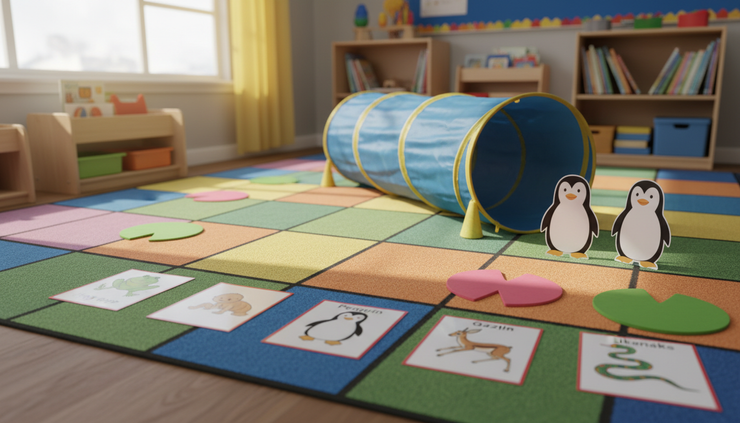
3. Create an animal movement obstacle course
An obstacle course turns vocabulary into an adventure. Use pillows, tape lines, hula hoops, tunnels, baskets, or cones.
Label each station with a picture and a word:
Hop across lily pads.
Crawl through the bear cave.
Waddle around the icebergs.
Leap over the river.
Slither under the branch.
Say the word before, during, and after the action. That repetition matters.
“We are going to slither.”
“You are slithering under the branch.”
“You slithered like a snake.”
This activity works especially well for active learners and children who need full-body movement before they can sit and talk. It also gives adults a natural way to model past, present, and future forms of verbs without turning the lesson into a grammar drill.
Use pictures, props, and stories to make words stick
Some children learn best when they can see, touch, or sort objects. Visual aids make animal verbs easier to remember because they give each word a clear image.
4. Match animal cards to movement cards
Make two sets of cards. One set shows animals. The other shows movement words or movement pictures.
Children can match:
Frog to hop
Snake to slither
Kangaroo to jump
Duck to waddle
Bird to fly
Fish to swim
For early learners, use pictures only. For older preschoolers, add printed words under the pictures. They may not read the full word yet, but they will start noticing shapes, letters, and labels.
To support different learning styles, let children choose how to respond:
Point to the matching card.
Act out the match.
Say the word.
Place the card on a sorting mat.
Make the animal sound before naming the movement.
You can also sort cards by speed or direction. Which animals move slowly? Which move up and down? Which move through water? These simple questions build flexible thinking and richer vocabulary.
5. Read picture books with “movement word moments”
Picture books are perfect for teaching Animal Movement vocabulary because they give children a story reason to care about the words.
During reading, pause when an animal moves. Ask children to show the movement with their hands or bodies.
If a rabbit jumps, children can make two fingers hop across the palm of one hand. If a bird flies, they can flap their arms gently. If a turtle crawls, they can move hands slowly across the floor.
Keep pauses short so the story still flows. Try this pattern:
Read the sentence.
Point to the animal.
Say the movement word.
Let children act it out for a few seconds.
Return to the story.
After reading, choose 3 movement words from the book and review them with pictures. Small sets work better than long lists, especially for younger preschoolers.
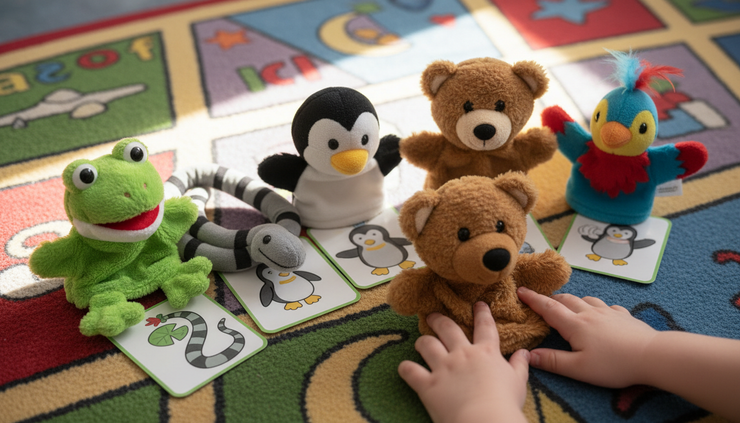
6. Use puppets to model and practice
Puppets make children feel less pressure. A shy child may not want to “slither” in front of the group, but they might happily help a snake puppet slither across the carpet.
Use a puppet to make playful mistakes.
Adult with puppet:
“Watch my frog slither!”
Children will often correct it right away.
“No, frogs hop!”
That correction shows understanding. It also gives children a fun reason to say the target word.
Try puppet prompts like:
“Can you teach Penguin how to waddle?”
“Snake forgot how to slither. Can you show Snake?”
“Bear is crawling too fast. Should Bear crawl slowly or quickly?”
“Bird wants to stomp. Is that how Bird moves?”
Puppets are helpful for mixed-age groups. Younger children can copy the puppet, while older children can explain the movement.
Add rhythm, sound, and creative play
Music and pretend play help children repeat words many times without feeling like they are drilling skills. Rhythm also supports children who learn well through sound and pattern.
7. Sing movement songs with repeatable verses
Take a familiar tune and swap in animal movement words. For example, use a simple chant:
“Can you hop, hop, hop like a frog?”
“Can you crawl, crawl, crawl like a bear?”
“Can you waddle, waddle, waddle like a duck?”
The tune does not need to be fancy. Children enjoy predictable lines because they know when to join in.
Add variety by changing the volume and speed:
Whisper the word and move quietly.
Sing loudly and make big movements.
Move in slow motion.
Move quickly, then freeze.
For toddlers and younger preschoolers, use 2 or 3 words per song. For older preschoolers, create a longer song and invite them to suggest animals.
8. Make a movement word sound band
Children love sound effects. Pair each movement word with a sound or rhythm.
Try these examples:
Movement | Sound idea | Body percussion |
Stomp | Boom, boom | Feet on floor |
Flutter | Swish, swish | Fingers rubbing together |
Gallop | Clip-clop | Hands patting thighs |
Slither | Ssssss | Palms sliding together |
Hop | Boing | One clap per jump |
Call out a movement word, then let children create the sound. After that, act it out.
This activity works well for auditory learners and children who enjoy music. It is also useful when space is limited. If the room is too small for galloping, children can make a gallop rhythm on their legs.
For an extra challenge, ask children to listen and guess.
Make the sound “clip-clop, clip-clop.”
Then ask, “Which movement is this?”
They may answer “gallop” or name the animal, such as horse. Both responses show they are making connections.
9. Invite children to draw movement paths
Drawing helps children who like quiet, visual, or fine motor activities. It also shows that movement has shape.
Give each child a paper with an animal picture. Ask them to draw how the animal moves:
A snake gets a curvy line.
A frog gets big arcs.
A butterfly gets loops.
A fish gets wavy lines.
A rabbit gets short bounces.
As they draw, use the vocabulary.
“Your snake is slithering in a long curve.”
“Your frog is leaping from lily pad to lily pad.”
“Your butterfly is fluttering around the flowers.”
This activity is great after a high-energy game because it keeps the animal theme going while helping children settle.
Older preschoolers can make a simple “movement map” with several animals. They might draw a pond where a frog hops, a tree where a bird flies, and grass where a cat prowls.

Bring vocabulary into everyday routines
The strongest vocabulary lessons usually happen more than once. A quick review during cleanup, outdoor play, or snack can be just as valuable as a planned lesson.
10. Use animal movement words during transitions
Transitions are a natural time to practice movement vocabulary. Instead of saying “line up,” try a playful cue:
“Waddle to the door like penguins.”
“Tiptoe like quiet cats.”
“Crawl like bears to the reading rug.”
“Flutter your hands as you walk to the table.”
“Stomp slowly to the cubbies.”
Set clear safety rules first. Children need to know which movements are okay indoors and which belong outside or in a gym space.
A helpful rule is: big animals outside, small animals inside.
Outside, children can gallop, leap, and run like cheetahs. Inside, they can tiptoe, waddle, flutter fingers, or crawl in a safe area.
This method works because it gives children many short chances to hear and use the same words. Over time, “waddle” and “slither” become part of their everyday language.
Match activities to ages and learning styles
A mixed preschool group often includes children with different attention spans, language levels, and comfort with movement. The same animal vocabulary can be taught in many ways.
Child or group need | Good activity choices | Helpful adjustment |
Younger preschoolers | Copycat games, songs, puppets | Use 2 to 4 words at a time |
Older preschoolers | Charades, sorting, obstacle courses | Ask them to explain or compare words |
Active learners | Freeze games, outdoor movement, obstacle courses | Build in clear start and stop signals |
Visual learners | Picture cards, books, drawing paths | Keep cards visible during play |
Auditory learners | Songs, chants, sound bands | Repeat words in a steady rhythm |
Shy or cautious children | Puppets, hand motions, seated choices | Let them participate without performing alone |
Multilingual learners | Pictures, gestures, repeated sentence frames | Pair the English word with clear action |
The goal is not to make every child participate in the exact same way. The goal is to give many paths into the same word.
Simple tips that make the lesson more fun
A few small choices can make animal movement lessons run more smoothly.
Teach in small sets. Three to five words are enough for one activity. You can always add more later.
Repeat without sounding repetitive. Say the word in a song, a story, a game, and a transition.
Use real photos and simple drawings. Photos help children connect words to real animals. Drawings are useful because they show movement clearly.
Celebrate creative answers. A child might say a crab “walks sideways” before learning “scuttles.” That is a strong observation. Give the new word after accepting the idea.
Model safe movement. Show how to gallop without bumping, leap without crashing, and crawl without stepping on fingers.
Use full sentences. Instead of only saying “hop,” say, “The frog hops.” Children hear grammar patterns while learning vocabulary.
Keep it playful. Silly moments help words stick. Let the penguin puppet try to fly or the snake try to gallop, then invite children to fix the mistake.
A cheerful way to build vocabulary
Animal movement words are a wonderful fit for preschool because they meet children where they are. They invite motion, sound, imagination, and laughter. A child can see a frog, hop across the rug, chant the word, draw a hopping path, and use the word again while lining up for recess.
That kind of learning feels like play, but it builds real language.
Start with a few favorite animals this week. Pick one movement game, one visual aid, and one story. Keep the words simple, repeat them often, and enjoy the moment when a child proudly announces, “I can waddle like a penguin!”
Comments